Mother Rino and Her Baby Drawings Elephants Without Ears
| Sumatran rhinoceros[1] Temporal range: | |
|---|---|
 | |
| Sumatran rhinoceros at Sumatran Rhino Sanctuary in Lampung, Indonesia | |
| Conservation status | |
| | |
| CITES Appendix I (CITES)[3] | |
Scientific nomenclature  | |
| Kingdom: | Animalia |
| Phylum: | Chordata |
| Grade: | Mammalia |
| Gild: | Perissodactyla |
| Family: | Rhinocerotidae |
| Genus: | Dicerorhinus |
| Species: | D. sumatrensis |
| Binomial name | |
| Dicerorhinus sumatrensis (Fischer, 1814)[4] | |
| Subspecies | |
| |
 | |
| Sumatran rhinoceros range [two] [5] [6] | |

The Sumatran rhinoceros, as well known equally the hairy rhino or Asian 2-horned rhino (Dicerorhinus sumatrensis), is a rare fellow member of the family Rhinocerotidae and one of five extant species of rhinoceros. Information technology is the only extant species of the genus Dicerorhinus . It is the smallest rhinoceros, although it is still a big mammal; it stands 112–145 cm (3.67–4.76 ft) high at the shoulder, with a head-and-body length of 2.36–3.18 k (7.vii–ten.4 ft) and a tail of 35–70 cm (14–28 in). The weight is reported to range from 500 to 1,000 kg (1,100 to 2,200 lb), averaging 700–800 kg (1,540–1,760 lb), although at that place is a unmarried record of a 2,000 kg (iv,410 lb) specimen. Like both African species, it has two horns; the larger is the nasal horn, typically xv–25 cm (v.9–9.8 in), while the other horn is typically a stub. A glaze of cherry-brown hair covers most of the Sumatran rhino's torso.
Members of the species once inhabited rainforests, swamps, and cloud forests in Bharat, Kingdom of bhutan, Bangladesh, Myanmar, Laos, Thailand, Malaysia, Indonesia, and China. In historical times, they lived in southwest China, particularly in Sichuan.[vii] [eight] They are now critically endangered, with only five substantial populations in the wild: four in Sumatra and one in Borneo. Their numbers are difficult to make up one's mind because they are solitary animals that are widely scattered across their range, but they are estimated to number fewer than fourscore.[ix] [ten] The species was completely extirpated from Malaysia in 2019, and one of the Sumatran populations may already exist extinct. In 2015, researchers announced that the Bornean rhinoceros had become extinct from the northern part of Kalimantan (Sabah, Malaysia);[xi] however, a tiny population was discovered in E Kalimantan in early on 2016.[12]
The Sumatran rhino is a mostly alone animal except for courtship and offspring-rearing. It is the almost vocal rhino species and also communicates through marking soil with its anxiety, twisting saplings into patterns, and leaving excrement. The species is much better studied than the similarly reclusive Javan rhinoceros, in part because of a programme that brought 40 Sumatran rhinos into captivity with the goal of preserving the species. There was trivial or no information about procedures that would assist in ex situ breeding. Though a number of rhinos died once at the various destinations and no offspring were produced for nearly 20 years, the rhinos were all doomed in their soonhoped-for-logged wood.[thirteen] In March 2016, a Sumatran rhino (of the Bornean rhinoceros subspecies) was spotted in Indonesian Borneo.[14]
The Indonesian ministry building of Environment, began an official counting of the Sumatran rhinoceros in Feb 2019, planned to be completed in iii years.[xv] Malaysia'south last known balderdash and cow Sumatran rhinoceroses died in May and November 2019, respectively. The species is now considered to exist locally extinct in that country, and only survives in Republic of indonesia. In that location are fewer than fourscore left in existence.[xvi] According to the World Wildlife Fund, their numbers are xxx.[17]
Taxonomy and naming [edit]

First drawing of the first specimen known to Western science, by William Bell, 1793
The first documented Sumatran rhinoceros was shot 16 km (ix.9 mi) outside Fort Marlborough, well-nigh the west coast of Sumatra, in 1793. Drawings of the animal, and a written description, were sent to the naturalist Joseph Banks, then president of the Royal Society of London, who published a paper on the specimen that year.[18] In 1814, the species was given a scientific proper noun by Johann Fischer von Waldheim.[nineteen] [20]
The specific epithet sumatrensis signifies "of Sumatra", the Indonesian island where the rhinos were first discovered.[21] Carl Linnaeus originally classified all rhinos in the genus, Rhinoceros; therefore, the species was originally identified equally Rhinoceros sumatrensis or sumatranus.[22] Joshua Brookes considered the Sumatran rhino, with its two horns, a distinct genus from the one-horned Rhinoceros, and gave it the name Didermocerus in 1828. Constantin Wilhelm Lambert Gloger proposed the name Dicerorhinus in 1841. In 1868, John Edward Grey proposed the proper noun Ceratorhinus. Normally, the oldest proper name would be used, merely a 1977 ruling past the International Committee on Zoological Nomenclature established the proper genus name as Dicerorhinus.[4] [23] Dicerorhinus comes from the Greek terms di ( δι , meaning "2"), cero ( κέρας , significant "horn"), and rhinos ( ρινος , pregnant "nose").[24]
The 3 subspecies are:
D. south. sumatrensis , known every bit the western Sumatran rhino, which has only 75 to 85 rhinos remaining, mostly in the national parks of Bukit Barisan Selatan and Kerinci Seblat, Gunung Leuser in Sumatra, merely likewise in Way Kambas National Park in small numbers.[2] They have recently gone extinct in Peninsular Malaysia. The principal threats confronting this subspecies are habitat loss and poaching. A slight genetic departure is noted between the western Sumatran and Bornean rhinos.[ii] The rhinos in Peninsular Malaysia were once known equally D. southward. niger, but were later recognized to be a synonym of D. s. sumatrensis.[4] Three bulls and four cows currently alive in captivity at the Sumatran Rhino Sanctuary at Style Kambas, the youngest balderdash having been bred and born there in 2012.[25] Another calf, a female, was born at the sanctuary in May 2016.[26] The sanctuary's ii bulls were born at the Cincinnati Zoo and Botanical Garden.[27]
D. s. harrissoni , known as the Bornean rhino or eastern Sumatran rhinoceros, which was one time common throughout Borneo; now merely almost 15 individuals are estimated to survive.[12] The known population lives in East Kalimantan, with them having recently gone extinct in Sabah.[28] Reports of animals surviving in Sarawak are unconfirmed.[2] This subspecies is named after Tom Harrisson, who worked extensively with Bornean zoology and anthropology in the 1960s.[29] The Bornean subspecies is markedly smaller in torso size than the other ii subspecies.[iv] The captive population consisted of one balderdash and ii cows at the Borneo Rhinoceros Sanctuary in Sabah; the bull died in 2019 and the cows died in 2017 and 2019 respectively.[30] [31]
D. south. lasiotis , known every bit the northern Sumatran rhinoceros or Chittagong rhino, which once roamed Republic of india and Bangladesh, has been alleged extinct in these countries. Unconfirmed reports propose a small population may nonetheless survive in Myanmar, but the political situation in that state has prevented verification.[ii] The name lasiotis is derived from the Greek for "hairy-ears". Afterwards studies showed that their ear hair was not longer than other Sumatran rhinos, but D. s. lasiotis remained a subspecies considering it was significantly larger than the other subspecies.[four]
Evolution [edit]
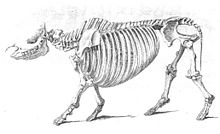
Skeleton of the Sumatran rhinoceros
Ancestral rhinoceroses first diverged from other perissodactyls in the Early Eocene. Mitochondrial Deoxyribonucleic acid comparing suggests the ancestors of modern rhinos split up from the ancestors of Equidae around 50 meg years agone.[32] [33] The extant family, the Rhinocerotidae, first appeared in the Tardily Eocene in Eurasia, and the ancestors of the extant rhino species dispersed from Asia beginning in the Miocene.[34]
The Sumatran rhinoceros is considered the least derived of the extant species, as information technology shares more than traits with its Miocene ancestors.[35] : thirteen Paleontological bear witness in the fossil record dates the genus Dicerorhinus to the Early Miocene, 23–sixteen meg years ago. Many fossils take been classified as members of Dicerorhinus, just no other recent species are in the genus.[36] Molecular dating suggests the split up of Dicerorhinus from the four other extant species as far back as 25.nine ± 1.9 million years. Three hypotheses take been proposed for the relationship betwixt the Sumatran rhinoceros and the other living species. 1 hypothesis suggests the Sumatran rhinoceros is closely related to the black and white rhinos in Africa, evidenced past the species having ii horns, instead of one.[32] Other taxonomists regard the Sumatran rhino as a sister taxon of the Indian and Javan rhinoceros because their ranges overlap so closely.[32] [37] A 3rd hypothesis, based on more contempo analyses, yet, suggests that the two African rhinos, the 2 Asian rhinos, and the Sumatran rhinoceros correspond three substantially dissever lineages that split around 25.9 million years agone; which group diverged outset remains unclear.[32] [38] Recent studies suggest that many specimens attributed to Dicerorhinus from the Pleistocene of Prc actually belong to Stephanorhinus, a closely related genus.[39] The earliest fossil tape of the species is from the Early Pleistocene Liucheng Gigantopithecus Cave in Guangxi, People's republic of china, which consists of a nearly complete mandible with preserved cheek teeth and various isolated teeth.[40]
Because of morphological similarities, the Sumatran rhinoceros is believed to exist closely related to the extinct woolly rhinoceros (Coelodonta antiquitatis) and Stephanorhinus. The woolly rhinoceros, then named for the coat of hair it shares with the Sumatran rhinoceros, outset appeared in Mainland china; past the Upper Pleistocene, it ranged beyond the Eurasian continent from Korea to Spain. The woolly rhino survived the final ice age, just, like the woolly mammoth, most or all became extinct around 10,000 years ago. Stephanorhinus species are well known in Europe from the Late Pliocene through the Pleistocene, and Prc from the Pleistocene, with two species, Stephanorhinus kirchbergensis and the Stephanorhinus hemitoechus surviving into the concluding glacial period. Although some morphological studies questioned the relationship,[38] recent molecular analysis has supported the shut human relationship.[41]
Pairwise sequential Markovian coalescent (PSMC) assay of a complete nuclear genome of a Sumatran specimen suggested strong fluctuations in population size, with a general trend of decline over the grade of the Middle to Late Pleistocene with an estimated top constructive population size of 57,800 individuals 950,000 years ago, failing to around 500–1,300 individuals at the get-go of the Holocene, with a slight rebound during the Eemian Interglacial. This was likely due to climatic change causing limiting suitable habitat for the Rhinoceros, causing severe population fluctuations as well equally population fragmentation due to the flooding of Sundaland. Human induced habitat change and hunting may have played a role in the Late Pleistocene.[42] The report was later criticised for not including DNA from extinct mainland populations, which would have provided a holistic account.[43] A Bayesian skyline plot of complete Mitochondrial genomes from multiple individuals from beyond the range of the species suggested that the population had been relatively stable with an constructive population size of twoscore,000 individuals over the last 400,000 years, with a sharp refuse starting effectually 25,000 years ago.[44]
Cladogram showing the relationships of recent and Belatedly Pleistocene rhino species (minus Stephanorhinus hemitoechus) based on whole nuclear genomes, afterward Liu et al, 2021:[45]
| |||||||||||||||||||||||||
Description [edit]
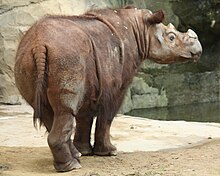
Sumatran rhinoceros at the Cincinnati Zoo in Cincinnati, Ohio
A mature Sumatran rhino stands well-nigh 120–145 cm (3.94–4.76 ft) loftier at the shoulder, has a body length of around 250 cm (8.2 ft), and weighs 500–800 kg (1,100–1,760 lb),[46] though the largest individuals in zoos have been known to weigh as much as ii,000 kg (iv,410 lb).[47] Like the 2 African species, it has two horns. The larger is the nasal horn, typically only 15–25 cm (5.9–9.viii in), though the longest recorded specimen was much longer at 81 cm (32 in).[46] The posterior horn is much smaller, usually less than 10 cm (3.nine in) long, and ofttimes little more than a knob. The larger nasal horn is also known as the inductive horn; the smaller posterior horn is known as the frontal horn.[36] The horns are nighttime grey or black in color. The bulls have larger horns than the cows, though the species is not otherwise sexually dimorphic. The Sumatran rhino lives an estimated 30–45 years in the wild, while the record time in captivity is a female D. lasiotis, which lived for 32 years and eight months before dying in the London Zoo in 1900.[36]
2 thick folds of skin encircle the trunk behind the front legs and before the hind legs. The rhino has a smaller fold of skin around its neck. The skin itself is thin, 10–xvi mm (0.39–0.63 in), and in the wild, the rhino appears to have no subcutaneous fatty. Hair can range from dense (the most dumbo hair in young calves) to scarce, and is normally a reddish brownish. In the wild, this hair is difficult to observe because the rhinos are frequently covered in mud. In captivity, however, the hair grows out and becomes much shaggier, likely because of less abrasion from walking through vegetation. The rhino has a patch of long hair around its ears and a thick clump of hair at the end of its tail. Like all rhinos, they have very poor vision. The Sumatran rhinoceros is fast and active; it climbs mountains easily and comfortably traverses steep slopes and riverbanks.[21] [36] [46]
Distribution and habitat [edit]

A rhino roaming the ruined city of Chiang Saen, northern Thailand, in 1867
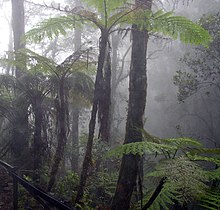
The Sumatran rhinoceros lives in both lowland and highland secondary rainforest, swamps, and cloud forests. It inhabits hilly areas shut to water, especially steep upper valleys with copious undergrowth. The Sumatran rhinoceros one time inhabited a continuous range as far north equally Burma, eastern India, and Bangladesh. Unconfirmed reports likewise placed it in Cambodia, Lao people's democratic republic, and Vietnam. All known living animals occur in the island of Sumatra. Some conservationists hope Sumatran rhinos may nonetheless survive in Burma, though it is considered unlikely. Political turmoil in Burma has prevented any assessment or study of possible survivors.[48] The terminal reports of stray animals from Indian limits were in the 1990s.[49]
The Sumatran rhino is widely scattered across its range, much more so than the other Asian rhinos, which has made it difficult for conservationists to protect members of the species finer.[48] Only iv areas are known to incorporate Sumatran rhino: Bukit Barisan Selatan National Park, Gunung Leuser National Park, and Way Kambas National Park on Sumatra; and on Indonesian Borneo west of Samarindah.[50]
The Kerinci Seblat National Park, Sumatra's largest, was estimated to contain a population of around 500 rhinos in the 1980s,[51] but due to poaching, this population is at present considered extinct. The survival of any animals in Peninsular Malaysia is extremely unlikely.[52]
Genetic analysis of Sumatran rhinoceros populations has identified iii singled-out genetic lineages.[20] The channel betwixt Sumatra and Malaysia was not as significant a barrier for the rhinos as the Barisan Mountains forth the length of Sumatra, for rhinos in eastern Sumatra and Peninsular Malaysia are more closely related than the rhinos on the other side of the mountains in western Sumatra. In fact, the eastern Sumatra and Malaysia rhinos show so little genetic variance, the populations were likely not separate during the Pleistocene, when sea levels were much lower and Sumatra formed part of the mainland. Both populations of Sumatra and Malaysia, notwithstanding, are shut plenty genetically that interbreeding would not be problematic. The rhinos of Borneo are sufficiently singled-out that conservation geneticists accept brash confronting crossing their lineages with the other populations.[20] Conservation geneticists have recently begun to study the diversity of the gene pool inside these populations past identifying microsatellite loci. The results of initial testing found levels of variability within Sumatran rhino populations comparable to those in the population of the less endangered African rhinos, only the genetic variety of Sumatran rhinos is an area of continuing report.[53]
Although the rhino had been thought to exist extinct in Kalimantan since the 1990s, in March 2013 Globe Wild animals Fund (WWF) appear that the team when monitoring orangutan activity plant in West Kutai Regency, Eastward Kalimantan, several fresh rhino foot trails, mud holes, traces of rhino-rubbed trees, traces of rhino horns on the walls of mud holes, and rhino bites on small branches. The team also identified that rhinos ate more than than 30 species of plants.[54] On 2 October 2013, video images fabricated with camera traps showing the Sumatran rhinoceros in Kutai Barat, Kalimantan, were released by the World Wildlife Fund. Experts assume the videos show two dissimilar animals, simply aren't quite certain. According to the Indonesia's Minister of Forestry, Zulkifli Hasan called the video evidence "very important" and mentioned Indonesia's "target of rhino population growth by three per centum per yr".[20] [55] On 22 March 2016 it was announced by the WWF that a live Sumatran rhino was constitute in Kalimantan; it was the first contact in over 40 years. The rhinoceros, a female, is being transported to a nearby sanctuary.[56]
Iman, the last known Sumatran rhino in Malaysia, died in November 2019; stem cell engineering is being used in an effort to revitalize the rhino's population and contrary extinction in the country.[57]
Behavior [edit]

Male person of the extinct D. s. lasiotis with a large front horn,[58] London Zoo around 1904
Sumatran rhinoceroses are lone creatures except for pairing before mating and during offspring rearing. Individuals have home ranges; bulls take territories as large as 50 km2 (19 sq mi), whereas cows' ranges are 10–15 kmii (3.9–five.8 sq mi).[21] The ranges of cows appear to exist spaced autonomously; bulls' ranges oft overlap. No evidence indicates Sumatran rhinos defend their territories through fighting. Marking their territories is washed by scraping soil with their feet, bending saplings into distinctive patterns, and leaving excrement. The Sumatran rhinoceros is usually most active when eating, at dawn, and just after dusk. During the mean solar day, they wallow in mud baths to absurd down and residuum. In the rainy flavour, they move to higher elevations; in the libation months, they render to lower areas in their range.[21] When mud holes are unavailable, the rhino will deepen puddles with its anxiety and horns. The wallowing behaviour helps the rhino maintain its trunk temperature and protect its skin from ectoparasites and other insects. Captive specimens, deprived of acceptable wallowing, have apace developed broken and inflamed skins, suppurations, eye problems, inflamed nails, and hair loss, and accept eventually died. One 20-calendar month study of wallowing behavior found they will visit no more than three wallows at any given time. Later two to 12 weeks using a particular wallow, the rhino will carelessness it. Typically, the rhino will wallow around midday for two to 3 hours at a fourth dimension before venturing out for food. Although in zoos the Sumatran rhino has been observed wallowing less than 45 minutes a day, the study of wild animals institute 80–300 minutes (an average of 166 minutes) per twenty-four hours spent in wallows.[59]
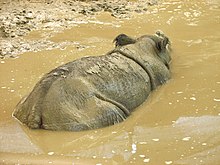
Sumatran rhino wallowing, Cincinnati Zoo
In that location has been little opportunity to study epidemiology in the Sumatran rhinoceros. Ticks and gyrostigma were reported to crusade deaths in captive animals in the 19th century.[46] The rhinoceros is also known to be vulnerable to the blood affliction surra, which tin can be spread past horse-flies carrying parasitic trypanosomes; in 2004, all five rhinos at the Sumatran Rhino Conservation Center died over an 18-day period after becoming infected past the disease.[60] The Sumatran rhino has no known predators other than humans. Tigers and wild dogs may be capable of killing a dogie, but calves stay close to their mothers, and the frequency of such killings is unknown. Although the rhinoceros'due south range overlaps with elephants and tapirs, the species do not appear to compete for food or habitat. Elephants (Elephas maximus) and Sumatran rhinos are even known to share trails, and many smaller species such as deer, boars, and wild dogs will use the trails the rhinos and elephants create.[21] [61]
The Sumatran rhino maintains trails across its range. These trails fall into 2 types. Primary trails will exist used by generations of rhinos to travel between important areas in the rhino's range, such equally between common salt licks, or in corridors through inhospitable terrain that separates ranges. In feeding areas, the rhinos will brand smaller trails, still covered past vegetation, to areas containing food the rhino eats. Sumatran rhino trails accept been plant that cross rivers deeper than 1.5 m (4.9 ft) and nigh 50 1000 (160 ft) beyond. The currents of these rivers are known to be strong, just the rhino is a stiff swimmer.[36] [46] A relative absenteeism of wallows near rivers in the range of the Sumatran rhinoceros indicates they may occasionally bathe in rivers in lieu of wallowing.[61]
Diet [edit]
Most feeding occurs just before nightfall and in the morn. The Sumatran rhino is a folivore,[63] with a diet of young saplings, leaves, twigs, and shoots.[36] The rhinos normally consume upwardly to 50 kg (110 lb) of nutrient a day.[21] Primarily by measuring dung samples, researchers have identified more than than 100 food species consumed by the Sumatran rhino. The largest portion of the nutrition is tree saplings with a trunk diameter of i–half-dozen cm (0.5–2.5 in). The rhinoceros typically pushes these saplings over with its body, walking over the sapling without stepping on it, to consume the leaves. Many of the establish species the rhinoceros consumes exist in only pocket-sized portions, which indicates the rhinoceros is oft changing its diet and feeding in different locations.[61] Among the most common plants the rhino eats are many species from the Euphorbiaceae, Rubiaceae, and Melastomataceae families. The about common species the rhinoceros consumes is Eugenia.[62]
The vegetal nutrition of the Sumatran rhinoceros is high in fiber and only moderate in protein.[64] Table salt licks are very important to the nutrition of the rhino. These licks can be modest hot springs, seepages of salty h2o, or mud-volcanoes. The salt licks also serve an of import social purpose for the rhinos—bulls visit the licks to choice up the scent of cows in oestrus. Some Sumatran rhinos, even so, live in areas where common salt licks are non readily available, or the rhinos have not been observed using the licks. These rhinos may get their necessary mineral requirements past consuming plants rich in minerals.[61] [62]
Advice [edit]
The Sumatran rhinoceros is the most vocal of the rhino species.[65] Observations of the species in zoos show the animal nigh constantly vocalizing, and it is known to do so in the wild, too.[46] The rhino makes three singled-out noises: eeps, whales, and whistle-blows. The eep, a short, one-2nd-long yelp, is the nigh common sound. The whale, named for its similarity to vocalizations of the humpback whale, is the about song-like vocalization and the second-most common. The whale varies in pitch and lasts from four to seven seconds. The whistle-blow is named because it consists of a two-second-long whistling noise and a burst of air in immediate succession. The whistle-blow is the loudest of the vocalizations, loud enough to make the iron confined in the zoo enclosure where the rhinos were studied vibrate. The purpose of the vocalizations is unknown, though they are theorized to convey danger, sexual readiness, and location, as do other ungulate vocalizations. The whistle-blow could exist heard at a great distance, fifty-fifty in the dense castor in which the Sumatran rhino lives. A vocalization of similar book from elephants has been shown to behave 9.eight km (half-dozen.1 mi) and the whistle-accident may carry as far.[65] The Sumatran rhinoceros volition sometimes twist the saplings they practise not eat. This twisting beliefs is believed to be used as a form of communication, frequently indicating a junction in a trail.[61]
Reproduction [edit]

Mother with four-day-old juvenile
Cows become sexually mature at the age of half dozen to seven years, while bulls become sexually mature at most 10 years old. The gestation catamenia is around 15–16 months. The calf, which typically weighs 40–threescore kg (88–132 lb), is weaned after near fifteen months and stays with its female parent for the get-go two to iii years of its life. In the wild, the birth interval for this species is estimated to be four to five years; its natural offspring-rearing behavior is unstudied.[21]
The reproductive habits of the Sumatran rhinoceros have been studied in captivity. Sexual relationships begin with a courtship menstruum characterized by increased vox, tail raising, urination, and increased physical contact, with both bull and cow using their snouts to bump the other in the head and genitals. The blueprint of courting is well-nigh similar to that of the black rhinoceros. Young Sumatran rhinoceros bulls are oftentimes too aggressive with cows, sometimes injuring and even killing them during the courtship. In the wild, the cow could run away from an overly aggressive bull, but in their smaller convict enclosures, they cannot; this inability to escape aggressive bulls may partly contribute to the low success rate of captive-breeding programs.[66] [67] [68]
The period of oestrus itself, when the cow is receptive to the bull, lasts almost 24 hours, and observations have placed its recurrence between 21 and 25 days. Sumatran rhinos in the Cincinnati Zoo have been observed copulating for thirty–l minutes, similar in length to other rhinos; observations at the Sumatran Rhinoceros Conservation Eye in Malaysia have shown a briefer copulation cycle. As the Cincinnati Zoo has had successful pregnancies, and other rhinos also have lengthy copulatory periods, a lengthy rut may be the natural behavior.[66] Though researchers observed successful conceptions, all these pregnancies concluded in failure for a variety of reasons until the showtime successful captive birth in 2001; studies of these failures at the Cincinnati Zoo discovered the Sumatran rhino'southward ovulation is induced by mating and it had unpredictable progesterone levels.[69] Breeding success was finally achieved in 2001, 2004, and 2007 by providing a pregnant rhino with supplementary progestin.[70] In 2016, a calf was built-in in captivity in western Indonesia, but the 5th such nascency in a breeding facility.[71]
Conservation [edit]

D. south. sumatrensis, Sumatran Rhino Sanctuary
In the wild [edit]
Sumatran rhinoceroses were once quite numerous throughout Southeast Asia. Fewer than 100 individuals are now estimated to remain.[2] [10] The species is classed as critically endangered (primarily due to illegal poaching) while the last survey in 2008 estimated that effectually 250 individuals survived.[72] [73] From the early on 1990s, the population decline was estimated at more than than 50% per decade, and the small-scale, scattered populations now face high risks of inbreeding depression.[2] Most remaining habitat is in relatively inaccessible mountainous areas of Indonesia.[74] [75]
Poaching of Sumatran rhinoceroses is a cause for concern, due to the high market price of its horn.[35] : 31 This species has been overhunted for many centuries, leading to the current profoundly reduced – and still failing – population.[2] The rhinos are difficult to observe and hunt directly (i field researcher spent 7 weeks in a treehide near a table salt lick without always observing a rhino directly), so poachers make use of spear traps and pit traps. In the 1970s, uses of the rhino's body parts among the local people of Sumatra were documented, such as the use of rhino horns in amulets and a folk belief that the horns offer some protection against poison. Dried rhinoceros meat was used equally medicine for diarrhea, leprosy, and tuberculosis. "Rhinoceros oil", a concoction fabricated from leaving a rhino's skull in coconut oil for several weeks, may be used to care for pare diseases. The extent of use and belief in these practices is non known.[46] [48] [61] Rhino horn was once believed to be widely used as an aphrodisiac; in fact traditional Chinese medicine never used it for this purpose.[35] : 29 Notwithstanding, hunting in this species has primarily been driven past a demand for rhino horns with unproven medicinal backdrop.[2]

Developed with juvenile, Cincinnati Zoo
The rainforests of Indonesia and Malaysia, which the Sumatran rhino inhabits, are too targets for legal and illegal logging considering of the desirability of their hardwoods. Rare woods such equally merbau, meranti and semaram are valuable on the international markets, fetching as much as $1,800 per grand3 ($1,375 per cu yd). Enforcement of illegal-logging laws is difficult because humans alive within or near many of the same forests as the rhinoceros. The 2004 Indian Sea earthquake has been used to justify new logging. Although the hardwoods in the rainforests of the Sumatran rhinoceros are destined for international markets and not widely used in domestic construction, the number of logging permits for these woods has increased dramatically considering of the tsunami.[50] Even so, while this species has been suggested to exist highly sensitive to habitat disturbance, apparently it is of fiddling importance compared to hunting, as it can withstand more than or less whatever forest status.[2] Still, the main cause of drastic reduction of the species is likely caused past the Allee effect.[76]
The Bornean rhino in Sabah was confirmed to exist extinct in the wild in Apr 2015, with only 3 individuals left in captivity.[77]
The mainland Sumatran rhino in Malaysia was confirmed to exist extinct in the wild in August 2015.[78]
In March 2016 at that place was a rare sighting of a Sumatran rhinoceros in Borneo, the Indonesian part of Borneo. The last time at that place was a Sumatran rhino in the Kalimantan area was approximately twoscore years ago. This optimism was met with despair as that very specific Sumatran rhino was plant dead several weeks later on afterward the sighting. The reason of the death is currently unknown.[79]
The Indonesian ministry of the Environment began an official counting of the Sumatran rhino in February 2019. The track and tally exercise was planned to be completed in three years.[fifteen]
In captivity [edit]

The female D. s. lasiotis "Begum", which was shown in London Zoo from xv February 1872 to 31 August 1900
Sumatran rhinoceroses practise not thrive exterior of their ecosystem. London Zoo acquired a bull and moo-cow in 1872 that had been captured in Chittagong in 1868. The female named "Begum" survived until 1900, the record lifetime for a captive rhinoceros.[lxxx] Begum was ane of at least seven specimens of the extinct subspecies D. southward. lasiotis that were held in zoos and circuses.[46] In 1972, Subur, the merely Sumatran rhino remaining in captivity, died at the Copenhagen Zoo.[46]
Despite the species' persistent lack of reproductive success, in the early on 1980s, some conservation organizations began a convict-breeding program for the Sumatran rhino. Between 1984 and 1996, this ex situ conservation program transported 40 Sumatran rhinos from their native habitats to zoos and reserves beyond the world. While hopes were initially high, and much research was conducted on the convict specimens, by the late 1990s, not a single rhino had been built-in in the program, and most of its proponents agreed the programme had been a failure. In 1997, the IUCN'due south Asian rhinoceros specialist grouping, which one time endorsed the program, declared information technology had failed "fifty-fifty maintaining the species within acceptable limits of mortality", noting that, in addition to the lack of births, 20 of the captured rhinos had died.[48] In 2004, a surra outbreak at the Sumatran Rhino Conservation Heart killed all the captive rhinos in Peninsular Malaysia, reducing the population of captive rhinos to eight.[threescore] [75]
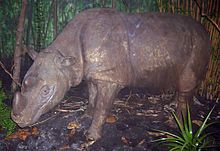
The preserved remains of the last Sumatran rhinoceros in captivity by the 1970s, a female chosen "Subur" which died in 1972. "Subur" ironically means "fertile" in Malay.
7 of these captive rhinos were sent to the Us (the other was kept in Southeast Asia), but by 1997, their numbers had dwindled to three: a cow in the Los Angeles Zoo, a balderdash in the Cincinnati Zoo, and a cow in the Bronx Zoo. In a final effort, the three rhinos were united in Cincinnati. Afterwards years of failed attempts, the cow from Los Angeles, Emi, became pregnant for the sixth fourth dimension, with the zoo's balderdash Ipuh. All five of her previous pregnancies ended in failure. Reproductive physiologist at the Cincinnati Zoo, Terri Roth, had learned from previous failures, though, and with the aid of special hormone treatments, Emi gave birth to a healthy male person dogie named Andalas (an Indonesian literary word for Sumatra) in September 2001.[81] Andalas's birth was the first successful captive birth of a Sumatran rhino in 112 years. A female calf, named "Suci" (Indonesian for "pure"), followed on 30 July 2004.[82] On 29 April 2007, Emi gave nascence a 3rd time, to her second male person calf, named Harapan (Indonesian for "hope") or Harry.[70] [83] In 2007, Andalas, who had been living at the Los Angeles Zoo, was returned to Sumatra to take part in convenance programs with healthy females,[68] [84] leading to the siring and 23 June 2012 nascency of male calf Andatu, the fourth convict-born dogie of the era; Andalas had been mated with Ratu, a wild-built-in cow living in the Rhino Sanctuary at Fashion Kambas National Park.[85]
Despite the recent successes in Cincinnati, the convict-breeding plan has remained controversial. Proponents argue that the zoos accept not but aided the conservation endeavor past studying the reproductive habits, raising public sensation and education about the rhinos, helping raise financial resources for conservation efforts in Sumatra merely, moreover, to accept established a small captive convenance group.[86] Opponents of the captive breeding programme fence that the losses are too great; the program is as well expensive; removing rhinos from their habitat, fifty-fifty temporarily, alters their ecological office; and convict populations cannot match the rate of recovery seen in well-protected native habitats.[68] In Oct 2015 Harapan, the last rhino in the Western Hemisphere, left the Cincinnati Zoo to Republic of indonesia.[87]

Sumatran rhinoceroses Emi and Harapan at the Cincinnati Zoo
In Baronial 2016, at that place were only 3 Sumatran rhinos left in Malaysia, all in captivity in the eastern state of Sabah: A bull named Tam and two cows named Puntung and Iman.[88] In June 2017, Puntung was put downwards due to skin cancer.[89] Tam died on 27 May 2019 and Iman died of cancer on 23 November 2019 at the Kalimantan Rhino Sanctuary.[90] [91] [92] [93] The species became extinct in Malaysia, its native land in 2019.[17]
In Republic of indonesia, meanwhile, a seventh rhinoceros increased the group at the Sumatran Rhino Sanctuary, in Manner Kambas NP. A female was born on 12 May 2016.[94]
Cultural depictions [edit]
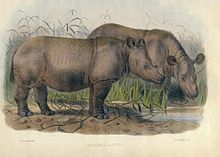
Illustration of 'Begum' from 1872
Bated from those few individuals kept in zoos and pictured in books, the Sumatran rhinoceros has remained trivial known, overshadowed by the more common Indian, black and white rhinos. Recently, however, video footage of the Sumatran rhino in its native habitat and in breeding centers has been featured in several nature documentaries. Extensive footage can be institute in an Asia Geographic documentary The Littlest Rhino. Natural History New Zealand showed footage of a Sumatran rhino, shot past freelance Indonesian-based cameraman Alain Compost, in the 2001 documentary The Forgotten Rhinoceros, which featured mainly Javan and Indian rhinos.[95] [96]
Though they were documented by droppings and tracks, pictures of the Bornean rhinoceros were beginning taken and widely distributed past modern conservationists in April 2006, when camera traps photographed a healthy adult in the jungles of Sabah in Malaysian Kalimantan.[97] On 24 April 2007, it was announced that cameras had captured the first-always video footage of a wild Bornean rhinoceros. The dark-time footage showed the rhino eating, peering through jungle leafage, and sniffing the pic equipment. The World Wildlife Fund, which took the video, has used it in efforts to convince local governments to turn the expanse into a rhino conservation zone.[98] [99] Monitoring has continued; 50 new cameras have been set upwards, and in February 2010, what appeared to be a pregnant rhino was filmed.[100]
A number of folk tales about the Sumatran rhino were collected by colonial naturalists and hunters from the mid-19th century to the early on 20th century. In Burma, the conventionalities was once widespread that the Sumatran rhinoceros ate burn down. Tales described the fire-eating rhino post-obit fume to its source, especially campfires, and and then attacking the camp. At that place was also a Burmese belief that the all-time time to hunt was every July, when the Sumatran rhinos would congregate beneath the total moon. In Malaya, it was said that the rhino'southward horn was hollow and could be used as a sort of hose for breathing air and squirting h2o. In Malaya and Sumatra, it was once believed that the rhino shed its horn every twelvemonth and buried it under the ground. In Borneo, the rhino was said to have a strange cannibal practice: after defecating in a stream, it would turn around and eat fish that had been stupefied by the excrement.[46]
References [edit]
- ^ Grubb, P. (2005). "Order Perissodactyla". In Wilson, D.E.; Reeder, D.One thousand (eds.). Mammal Species of the World: A Taxonomic and Geographic Reference (third ed.). Johns Hopkins University Press. p. 635. ISBN978-0-8018-8221-0. OCLC 62265494.
- ^ a b c d e f g h i j k Ellis, South.; Talukdar, B. (2020). "Dicerorhinus sumatrensis". IUCN Red List of Threatened Species. 2020: e.T6553A18493355. doi:x.2305/IUCN.U.k..2020-ii.RLTS.T6553A18493355.en . Retrieved xix November 2021.
- ^ Dicerorhinus sumatrensis Archived eight June 2019 at the Wayback Car Convention on International Trade in Endangered Species
- ^ a b c d e Rookmaaker, L. C. (1984). "The taxonomic history of the contempo forms of Sumatran Rhinoceros (Dicerorhinus sumatrensis)". Periodical of the Malayan Branch of the Majestic Asiatic Social club. 57 (1): 12–25. JSTOR 41492969.
- ^ Hegener, Michiel. "Distribution of the Sumatran rhino in 2017" (PDF). MichielHegener.nl . Retrieved 5 March 2021.
- ^ "Map past The National Geographic, 2018". Sumatran Rhino Survival Alliance . Retrieved 5 March 2021.
- ^ Chapman, Jan (1999) The Art of Rhinoceros Horn Carving in Red china. Christie's Books, London. ISBN 0-903432-57-9. p. 27
- ^ Schafer, Edward H. (1963) The Golden Peaches of Samarkand: A study of T'ang Exotics. University of California Press. Berkeley and Los Angeles. p. 83
- ^ "Rhino population figures". SaveTheRhino.org. 2015. Retrieved xvi May 2015.
- ^ a b Pusparini, W. et al. (2015) Correction: Rhinos in the Parks: An Isle-Wide Survey of the Concluding Wild Population of the Sumatran Rhinoceros. PLOS ONE 10(10): e0139982.
- ^ Havmøller, R.G. et al. (2015) Will electric current conservation responses save the Critically Endangered Sumatran rhinoceros Dicerorhinus sumatrensis? Oryx, 50(two):355–359.
- ^ a b "15 Bornean rhinos discovered in Kalimantan?". Mongabay. 14 March 2016. Retrieved three July 2016.
- ^ Nardelli, F. 2014 The last run a risk for the Sumatran rhino?. Pachyderm 55: 43–53 http://www.rhinoresourcecenter.com/index.php?s=1&act=refs&CODE=ref_detail&id=1411778068
- ^ "Rare Sumatran rhino sighted in Indonesian Borneo". Play tricks News. 23 March 2016. Retrieved 24 April 2016.
- ^ a b "To rescue Sumatran rhinos, Indonesia starts by counting them first". Mongabay Environmental News. fifteen April 2019. Retrieved 21 January 2020.
- ^ Williams, David; Ko, Stella (24 Nov 2019). "The terminal Sumatran rhinoceros in Malaysia has died and there are less than 80 left in the earth". CNN . Retrieved 27 November 2019.
- ^ a b "Sumatran rhinos are extinct in their native Malaysia subsequently final living female person dies". 23 November 2019. Retrieved 21 January 2020.
- ^ Banks, Sir Joseph; Bell, Due west. (10 Jan 1793). "Clarification of the Double Horned Rhinoceros of Sumatra. By Mr. William Bell, Surgeon in the Service of the Eastward India Company, at Bencoolen". Philosophical Transactions of the Royal Lodge. 83: three–6. doi:x.1098/rstl.1793.0003 – via Internet Archive.
- ^ Rookmaaker, Kees (2005). "First sightings of Asian rhinos". In Fulconis, R. (ed.). Save the rhinos: EAZA Rhino Entrada 2005/6. London: European Association of Zoos and Aquaria. p. 52.
- ^ a b c d Morales, Juan Carlos; Andau, Patrick Mahedi; Supriatna, Jatna; Zainal-Zahari, Zainuddin; Melnick, Don J. (April 1997). "Mitochondrial Deoxyribonucleic acid Variability and Conservation Genetics of the Sumatran Rhinoceros". Conservation Biology. 11 (ii): 539–543. doi:x.1046/j.1523-1739.1997.96171.x. S2CID 55337818.
- ^ a b c d east f yard van Strien, Nico (2005). "Sumatran rhinoceros". In Fulconis, R. (ed.). Save the rhinos: EAZA Rhino Entrada 2005/six. London: European Association of Zoos and Aquaria. pp. 70–74.
- ^ "Burmah", Encyclopædia Britannica, 9th ed., vol. Vol. IV, 1876, p. p. 552 .
- ^ International Commission on Zoological Nomenclature (1977). "Stance 1080. Didermocerus Brookes, 1828 (Mammalia) suppressed under the plenary powers". Bulletin of Zoological Classification, 34:21–24.
- ^ Liddell, Henry Grand.; Scott, Robert (1980). Greek-English Lexicon (Abridged ed.). Oxford: Oxford University Press. ISBN0-19-910207-iv.
- ^ International_Rhino_Foundation#Sumatran_Rhino_Sanctuary
- ^ Cota Larson, Rhishja (12 May 2016). "It'south a Girl! Critically Endangered Sumatran Rhino Born at Sanctuary in Indonesia". annamiticus.com . Retrieved 3 July 2016.
- ^ Sheridan, Kerry (22 September 2015). "Critically endangered Sumatran rhino pregnant: conservationists". phys.org . Retrieved 3 July 2016.
- ^ Hance, Jeremy (23 April 2015). "Officials: Sumatran rhino is extinct in the wild in Sabah". Mongabay. Archived from the original on 7 December 2015. Retrieved 3 July 2016.
- ^ Groves, C. P. (1965). "Clarification of a new subspecies of Rhinoceros, from Kalimantan, Didermocerus sumatrensis harrissoni". Saugetierkundliche Mitteilungen. 13 (three): 128–131.
- ^ Jeremy Hance (23 April 2015), Officials: Sumatran rhino is extinct in the wild in Sabah, Mongabay
- ^ Woodyatt, Amy (27 May 2019). "Malaysia'south last male person Sumatran rhino dies". CNN . Retrieved 28 May 2019.
- ^ a b c d Tougard, C.; T. Delefosse; C. Hoenni; C. Montgelard (2001). "Phylogenetic relationships of the five extant rhinoceros species (Rhinocerotidae, Perissodactyla) based on mitochondrial cytochrome b and 12s rRNA genes". Molecular Phylogenetics and Development. 19 (1): 34–44. doi:10.1006/mpev.2000.0903. PMID 11286489.
- ^ Xu, Xiufeng; Axel Janke; Ulfur Arnason (1 November 1996). "The Consummate Mitochondrial DNA Sequence of the Greater Indian Rhinoceros, Rhino unicornis, and the Phylogenetic Relationship Among Carnivora, Perissodactyla, and Artiodactyla (+ Cetacea)". Molecular Biology and Evolution. 13 (9): 1167–1173. doi:10.1093/oxfordjournals.molbev.a025681. PMID 8896369.
- ^ Lacombat, Frédéric (2005). "The development of the rhinoceros". In Fulconis, R. (ed.). Salve the rhinos: EAZA Rhino Campaign 2005/half dozen. London: European Association of Zoos and Aquaria. pp. 46–49.
- ^ a b c Dinerstein, Eric (2003). The Return of the Unicorns; The Natural History and Conservation of the Greater I-Horned Rhinoceros. New York: Columbia University Press. ISBN0-231-08450-ane.
- ^ a b c d e f Groves, Colin P.; Kurt, Fred (1972). "Dicerorhinus sumatrensis". Mammalian Species. American Society of Mammalogists (21): 1–6. doi:10.2307/3503818. JSTOR 3503818.
- ^ Groves, C. P. (1983). "Phylogeny of the living species of rhino" (PDF). Zeitschrift für Zoologische Systematik und Evolutionsforschung. 21 (4): 293–313. doi:10.1111/j.1439-0469.1983.tb00297.ten.
- ^ a b Cerdeño, Esperanza (1995). "Cladistic Analysis of the Family Rhinocerotidae (Perissodactyla)" (PDF). Novitates. American Museum of Natural History (3143). ISSN 0003-0082.
- ^ Tong, Hao-wen (Nov 2012). "Evolution of the not-Coelodonta dicerorhine lineage in Communist china". Comptes Rendus Palevol. 11 (8): 555–562. doi:ten.1016/j.crpv.2012.06.002.
- ^ Tong, Hao-wen; Guérin, Claude (July 2009). "Early Pleistocene Dicerorhinus sumatrensis remains from the Liucheng Gigantopithecus Cavern, Guangxi, China". Geobios. 42 (4): 525–539. doi:10.1016/j.geobios.2009.02.001.
- ^ Orlando, Ludovic; Leonard, Jennifer A.; Thenot, Aurélie; Laudet, Vincent; Guerin, Claude; Hänni, Catherine (September 2003). "Ancient Deoxyribonucleic acid analysis reveals woolly rhino evolutionary relationships" (PDF). Molecular Phylogenetics and Development. 28 (2): 485–499. doi:10.1016/S1055-7903(03)00023-X. PMID 12927133.
- ^ Mays, Herman 50.; Hung, Chih-Ming; Shaner, Pei-Jen; Denvir, James; Justice, Megan; Yang, Shang-Fang; Roth, Terri L.; Oehler, David A.; Fan, Jun; Rekulapally, Swanthana; Primerano, Donald A. (January 2018). "Genomic Analysis of Demographic History and Ecological Niche Modeling in the Endangered Sumatran Rhino Dicerorhinus sumatrensis". Current Biology. 28 (1): 70–76.e4. doi:10.1016/j.cub.2017.11.021. PMC5894340. PMID 29249659.
- ^ Lander, Brian; Brunson, Katherine (March 2018). "The Sumatran rhinoceros was extirpated from mainland East Asia by hunting and habitat loss". Electric current Biology. 28 (vi): R252–R253. doi:10.1016/j.cub.2018.02.012. PMID 29558637.
- ^ Steiner, Cynthia C.; Houck, Marlys Fifty.; Ryder, Oliver A. (Apr 2018). "Genetic variation of consummate mitochondrial genome sequences of the Sumatran rhinoceros (Dicerorhinus sumatrensis)". Conservation Genetics. 19 (two): 397–408. doi:10.1007/s10592-017-1011-1. ISSN 1566-0621. S2CID 4301239.
- ^ Liu, Shanlin; Westbury, Michael V.; Dussex, Nicolas; Mitchell, Kieren J.; Sinding, Mikkel-Holger Southward.; Heintzman, Peter D.; Duchêne, David A.; Kapp, Joshua D.; von Seth, Johanna; Heiniger, Holly; Sánchez-Barreiro, Fátima (August 2021). "Ancient and modern genomes unravel the evolutionary history of the rhino family". Jail cell. doi:10.1016/j.cell.2021.07.032. ISSN 0092-8674.
- ^ a b c d e f g h i j van Strien, N. J. (1974). "Dicerorhinus sumatrensis (Fischer), the Sumatran or two-horned rhinoceros: a study of literature". Mededelingen Landbouwhogeschool Wageningen. 74 (16): 1–82.
- ^ Groves, C. P.; Kurt, F. (1972). "Dicerorhinus sumatrenis" (PDF). Mammalian Species. 21 (21): ane–half dozen. doi:10.2307/3503818. JSTOR 3503818. Archived from the original (PDF) on ane November 2012.
- ^ a b c d Foose, Thomas J.; van Strien, Nico (1997). Asian Rhinos – Status Survey and Conservation Action Plan. IUCN, Gland, Switzerland, and Cambridge, UK. ISBNii-8317-0336-0.
- ^ Choudhury, A. U. (1997). "The status of the Sumatran rhinoceros in north-eastern India" (PDF). Oryx. 31 (2): 151–152. doi:x.1046/j.1365-3008.1997.d01-9.10.
- ^ a b Dean, Cathy; Tom Foose (2005). "Habitat loss". In Fulconis, R. (ed.). Salve the rhinos: EAZA Rhinoceros Campaign 2005/6. London: European Association of Zoos and Aquaria. pp. 96–98.
- ^ "Rhino population at Indonesian reserve drops by 90 percent in 14 years". SOS Rhino. 18 March 2012
- ^ "Sumatran rhinoceros numbers revised downwards". Relieve The Rhinoceros. 18 March 2012.
- ^ Scott, C.; Foose, T.; Morales, J. C.; Fernando, P.; Melnick, D. J.; Boag, P. T.; Davila, J. A.; Van Coeverden de Groot, P. J. (2004). "Optimization of novel polymorphic microsatellites in the endangered Sumatran rhinoceros (Dicerorhinus sumatrensis)" (PDF). Molecular Environmental Notes. Blackwell Publishing Ltd. four (ii): 194–196. doi:10.1111/j.1471-8286.2004.00611.x.
- ^ "Traces of Sumatran rhino found in Kalimantan". 29 March 2013. Archived from the original on 1 April 2013.
- ^ Erwida Maulia (2 October 2013). "Sumatran Rhino Defenseless on Camera in E Kalimantan". The Jakarta World. Archived from the original on 23 March 2014. Retrieved 2 August 2014.
- ^ "New hope for Sumatran rhino in Borneo". 22 March 2016.
- ^ Jessie Yeung. "Every Sumatran rhino has died in Malaysia. Scientists desire to bring them back with cloning engineering". CNN . Retrieved xviii Baronial 2020.
- ^ Rookmaaker, L. C. (1998). The rhinoceros in captivity: a list of 2439 rhinoceroses kept from Roman times to 1994. Kugler Publications. pp. 125–. ISBN978-90-5103-134-8.
- ^ Julia Ng, S.C.; Z. Zainal-Zahari; Adam Nordin (2001). "Wallows and Wallow Utilization of the Sumatran Rhino (Dicerorhinus Sumatrensis) in a Natural Enclosure in Sungai Dusun Biological reserve, Selangor, Malaysia" (PDF). Periodical of Wild animals and Parks. 19: 7–12.
- ^ a b Mohamad, Aidi; Vellayan, S.; Radcliffe, Robin W.; Lowenstine, Linda J.; Epstein, Jon; Reid, Simon A.; Paglia, Donald E.; Radcliffe, Rolfe Thousand.; Roth, Terri L.; Foose, Thomas J.; Mohamad Khan bin Momin Khan (2006). "Trypanosomiasis (surra) in the captive Sumatran rhinoceros (Dicerorhinus sumatrensis sumatrensis) in Peninsular Malaysia" (PDF). Proceedings of the Quaternary Rhino Keepers Workshop 2005 at Columbus, Ohio.
- ^ a b c d e f thousand Borner, Markus (1979). A field report of the Sumatran rhino Dicerorhinus sumatrensis Fischer, 1814: Ecology and behaviour conservation situation in Sumatra. Zurich: Juris Druck & Verlag. ISBN3-260-04600-3.
- ^ a b c Lee, Yook Heng; Stuebing, Robert B.; Ahmad, Abdul Hamid (1993). "The Mineral Content of Food Plants of the Sumatran Rhino (Dicerorhinus sumatrensis) in Danum Valley, Sabah, Malaysia" (PDF). Biotropica. The Association for Tropical Biology and Conservation. three (5): 352–355. doi:10.2307/2388795. JSTOR 2388795.
- ^ Nardelli, F. 2013 The mega-folivorous mammals of the rainforest: feeding ecology in nature and in a controlled environment: A contribution to their conservation. International Zoo News 60 (5): 323–339 http://www.rhinoresourcecenter.com/index.php?southward=one&act=refs&Code=ref_detail&id=1382831824
- ^ Dierenfeld, Due east. S.; Kilbourn, A.; Karesh, Westward.; Bosi, E.; Andau, Thou.; Alsisto, S. (2006). "Intake, utilization, and composition of browses consumed by the Sumatran rhino (Dicerorhinus sumatrensis harrissoni) in captivity in Sabah, Malaysia". Zoo Biology. 25 (5): 417–431. doi:10.1002/zoo.20107.
- ^ a b c von Muggenthaler, Elizabeth; Paul Reinhart; Brad Limpany; R. Barton Craft (2003). "Songlike vocalizations from the Sumatran Rhinoceros (Dicerorhinus sumatrensis)" (PDF). Acoustics Research Messages Online. 4 (3): 83. doi:x.1121/1.1588271.
- ^ a b Zainal Zahari, Z.; Rosnina, Y.; Wahid, H.; Yap, K. C.; Jainudeen, M. R. (2005). "Reproductive behaviour of captive Sumatran rhinoceros (Dicerorhinus sumatrensis)" (PDF). Brute Reproduction Science. 85 (iii–4): 327–335. doi:10.1016/j.anireprosci.2004.04.041. PMID 15581515.
- ^ Zainal-Zahari, Z.; Rosnina, Y.; Wahid, H.; Jainudeen, K. R. (2002). "Gross Anatomy and Ultrasonographic Images of the Reproductive Organisation of the Sumatran Rhinoceros (Dicerorhinus sumatrensis)" (PDF). Anatomia, Histologia, Embryologia. 31 (6): 350–354. doi:10.1046/j.1439-0264.2002.00416.x. PMID 12693754. S2CID 19009013. Archived from the original (PDF) on 19 January 2018.
- ^ a b c Roth, Terri L.; Radcliffem, Robin West.; van Strien, Nico J. (2006). "New hope for Sumatran rhinoceros conservation" (PDF). International Zoo News (abridged from Communiqué ed.). 53 (half-dozen): 352–353.
- ^ Roth, T. Fifty.; O'Brien, J. Thousand.; McRae, 1000. A.; Bellem, A. C.; Romo, S. J.; Kroll, J. L.; Brownish, J. L. (2001). "Ultrasound and endocrine evaluation of the ovarian cycle and early pregnancy in the Sumatran rhino, Dicerorhinus sumatrensis" (PDF). Reproduction. 121 (1): 139–149. doi:10.1530/rep.0.1210139. hdl:10088/324. PMID 11226037.
- ^ a b Roth, T. L. (2003). "Breeding the Sumatran rhinoceros (Dicerorhinus sumatrensis) in captivity: behavioral challenges, hormonal solutions" (PDF). Hormones and Behavior. 44: 31. doi:10.1016/S0018-506X(03)00068-0. S2CID 54311703.
- ^ "Sumatran rhino birth hailed equally major boost for the critically endangered species". ABC News. xiv May 2016. Retrieved xv January 2021.
- ^ "Final run a risk for the Sumatran rhinoceros". IUCN. four April 2013. Retrieved ii Baronial 2014.
- ^ "Sumatran rhinoceros population plunges, down to 100 animals". News.mongabay.com. 8 April 2013. Retrieved two August 2014.
- ^ Rabinowitz, Alan (1995). "Helping a Species Go Extinct: The Sumatran Rhinoceros in Borneo" (PDF). Conservation Biology. nine (three): 482–488. doi:10.1046/j.1523-1739.1995.09030482.x. Archived from the original (PDF) on x August 2014.
- ^ a b van Strien, Nico J. (2001). "Conservation Programs for Sumatran and Javan Rhino in Republic of indonesia and Malaysia". Proceedings of the International Elephant and Rhino Research Symposium, Vienna, 7–eleven June 2001. Scientific Progress Reports.
- ^ Payne J. 2016. https://wildtech.mongabay.com/2016/01/reproductive-engineering-and-understanding-of-experimental-psychology-needed-to-save-a-critically-endangered-rhino/
- ^ Hance, Jeremy (23 Apr 2015). "Officials: Sumatran rhino is extinct in the wild in Sabah". news.mongabay.com . Retrieved 27 April 2015.
- ^ "Officials:Sumatran rhino now extinct in Malaysian wild". Free Malaysia Today. 21 August 2015. Archived from the original on 24 September 2015. Retrieved 21 August 2015.
- ^ "Sumatran rhino dies weeks after rare sighting". CNN. half-dozen April 2016. Retrieved eight April 2016.
- ^ Lydekker, Richard (1900). The great and small-scale game of Bharat, Burma, and Tibet. Asian Educational Services. ISBN978-81-206-1162-seven.
- ^ "Andalas – A Living Legacy". Cincinnati Zoo. Archived from the original on 17 November 2007. Retrieved 4 November 2007.
- ^ "It'southward a Girl! Cincinnati Zoo'south Sumatran Rhino Makes History with Second Calf". Cincinnati Zoo. Archived from the original on 27 October 2007. Retrieved 4 November 2007.
- ^ "Meet "Harry" the Sumatran Rhino!". Cincinnati Zoo. Archived from the original on 17 November 2007. Retrieved 4 November 2007.
- ^ Watson, Paul (26 Apr 2007). "Come up into my mud pool". The Los Angeles Times . Retrieved five December 2011.
- ^ "Rare baby Sumatra rhinoceros named a 'gift from God'". Djakarta World. Agence France-Presse. 26 June 2012. Archived from the original on 10 August 2014. Retrieved ii Baronial 2014.
- ^ Nardelli F. 2016. Do nosotros really desire to salve the Sumatran rhino? (commentary). mongabay.com Apr 2016 http://www.rhinoresourcecenter.com/index.php?southward=1&act=refs&Code=ref_detail&id=1469019235
- ^ United states of america-built-in endangered Sumatran rhino arrives in ancestral dwelling house of Indonesia on mating mission. Associated Press. (one November 2015)
- ^ "Only three Sumatran Rhino left in Malaysia". New Straits Times. 26 Baronial 2016. Retrieved 28 Baronial 2016.
- ^ "Puntung euthanised leaves Malaysia with simply ii Sumatran rhinos". The Malay Mail Online. 4 June 2017. Retrieved four June 2017.
- ^ "Malaysia's last Sumatran rhino Iman dies, species now extinct in the country". Retrieved 23 Nov 2019.
- ^ "Malaysia'south last male Sumatran rhinoceros Tam dies". The Malay Mail Online. 27 May 2019. Retrieved 27 May 2019.
- ^ "Malaysia's last known Sumatran rhino dies". 23 November 2019. Retrieved 23 November 2019.
- ^ "Last male Sumatran rhino in Malaysia dies". Animals. 27 May 2019. Retrieved 24 November 2019.
- ^ "Rare Sumatran rhinoceros calf born in Indonesia". phys.org.
- ^ "The Littlest Rhino". Asia Geographic. Archived from the original on 9 October 2007. Retrieved 6 December 2007.
- ^ "The Forgotten Rhino". NHNZ. Archived from the original on 1 October 2006. Retrieved 6 December 2007.
- ^ "Rhinos alive and well in the last frontier". New Straits Times (Malaysia). 2 July 2006.
- ^ "Rhino on camera was rare sub-species: wildlife group". Agence French republic Presse. 25 Apr 2007.
- ^ Video of the Sumatran rhinoceros is available at "Asian rhinos". World Wildlife Fund.
- ^ "Endangered meaning Kalimantan rhinoceros caught on photographic camera". The Telegraph. 21 April 2010. Archived from the original on 24 Apr 2010.
External links [edit]
- Sumatran Rhino Info & Sumatran Rhino Pictures on the Rhino Resources Centre
- Sumatran Rhinoceros at Arkive.
- Rhino and Forest Fund
- Borneo Rhinoceros Alliance
Source: https://en.wikipedia.org/wiki/Sumatran_rhinoceros
0 Response to "Mother Rino and Her Baby Drawings Elephants Without Ears"
Post a Comment